
Personal Style and Outfit Ideas That Flatter Your Body Beyond Strict Rules
Personal style is the way you use clothing, accessories, color, and fit to express yourself and feel comfortable in what you wear. Outfits that flatter your body do not depend on rigid rules about “dressing for” a particular shape; they come from noticing what you enjoy, how garments fit and move, and what suits the occasions you dress for. Research from the fashion discovery platform Lyst has found that searches for fashion are shaped by a mix of identity, culture, and trends, while the U.S. Environmental Protection Agency estimates that Americans generated 17 million tons of textile waste in 2018. Choosing versatile clothes you genuinely like can therefore support both confidence and more thoughtful wardrobe decisions. The sections below cover fit, proportion, color, personal preference, and practical outfit formulas for building a style that works for you.
Personal style supports body-flattering outfit choices
Personal style is an individual approach to dressing, shaped by preferences, lifestyle, culture, budget, and practical needs. The Fashion Institute of Technology’s Museum at FIT presents fashion as a form of visual and cultural expression, rather than a fixed set of rules. In everyday terms, a flattering outfit is one that feels good to wear and creates the effect you want—whether that means a relaxed silhouette, a defined waist, a longer-looking line, or simply a favorite color near your face.
There is no single scientifically established body-shape formula that determines what everyone should wear. Categories such as pear, apple, rectangle, and hourglass are informal styling labels, not medical classifications or reliable predictors of personal taste. A more useful approach is to assess individual garments and outfit combinations: Does the fabric sit comfortably? Can you move easily? Do you like the silhouette? Does it suit the day ahead?
Fit and comfort
Fit describes how a garment sits on the body, including its ease, length, and placement at the shoulders, waist, hips, and hem. Comfort includes how the fabric feels and whether the clothing allows you to sit, walk, reach, and move as needed. A well-fitting item does not have to be tight or tailored: ease, drape, and an intentionally oversized shape can all be flattering when they are chosen on purpose.
A practical check is to try clothes in the positions you will use them in. Sit down in trousers, reach forward in a jacket, and walk in shoes before deciding. If a garment pulls, shifts, or irritates you, consider another size, a different cut, or alterations. The U.S. Bureau of Labor Statistics’ Consumer Expenditure data tracks household spending on apparel and services, including alterations and repair, reflecting that fit can be adjusted rather than treated as all-or-nothing.
Proportion and silhouette
Proportion is the visual relationship between parts of an outfit, such as a jacket’s length in relation to trousers or the volume of a top compared with a skirt. A silhouette is the overall outline created by clothing. These are styling tools, not body-correction rules: you can use contrast to create a focal point, repeat a shape for a cohesive look, or deliberately mix volume for a relaxed effect.
For example, a short jacket over wide-leg trousers creates a different proportion from a long cardigan over the same trousers. Neither is automatically better; the choice depends on your preferred look and the setting. A full-length mirror or a quick outfit photo can help you see the overall outline, especially when experimenting with layers.
Color, texture, and details shape a flattering outfit
Once fit and silhouette feel comfortable, color and surface details offer additional ways to personalize an outfit. Color can create contrast, harmony, or emphasis, while texture and pattern affect how a garment catches the eye. Instead of relying on prescriptive color-season systems, test clothing in natural light and notice which combinations you enjoy wearing.
Color and contrast
Color is a visual feature that can be used to coordinate pieces or draw attention to a particular part of an outfit. Contrast refers to the difference between colors or between light and dark values. A monochromatic outfit uses variations of one color; a high-contrast outfit pairs noticeably different shades. Both can work across different body types and styles.
Try a simple experiment: hold two tops near your face in daylight and compare how each makes you feel. You might prefer a bright color, a muted neutral, or a combination that reflects your mood. If you are unsure where to begin, use a neutral base—such as navy, brown, gray, or cream—and add one color through a shirt, scarf, bag, or shoe.
Pattern, texture, and focal points
Pattern is a repeated visual design, such as stripes, checks, or florals; texture is the surface quality of a fabric, such as denim’s firmness or knitwear’s softness. Accessories and garment details can create focal points without changing the basic silhouette. A patterned shirt, a textured jacket, or a distinctive necklace can make a familiar outfit feel more personal.
If you want a balanced look, repeat one color from a patterned item elsewhere in your outfit. If you prefer a bolder effect, combine patterns with a shared color or similar scale. These are optional coordination techniques, not requirements: intentional contrast can be expressive, too.
Outfit formulas make personal style easier to use
An outfit formula is a repeatable combination of clothing pieces that can be adapted to different days. It reduces decision-making while leaving room for individual taste. The best formula is not a prescribed uniform; it is a starting point that works with your schedule, climate, comfort needs, and available wardrobe.
Casual everyday combinations
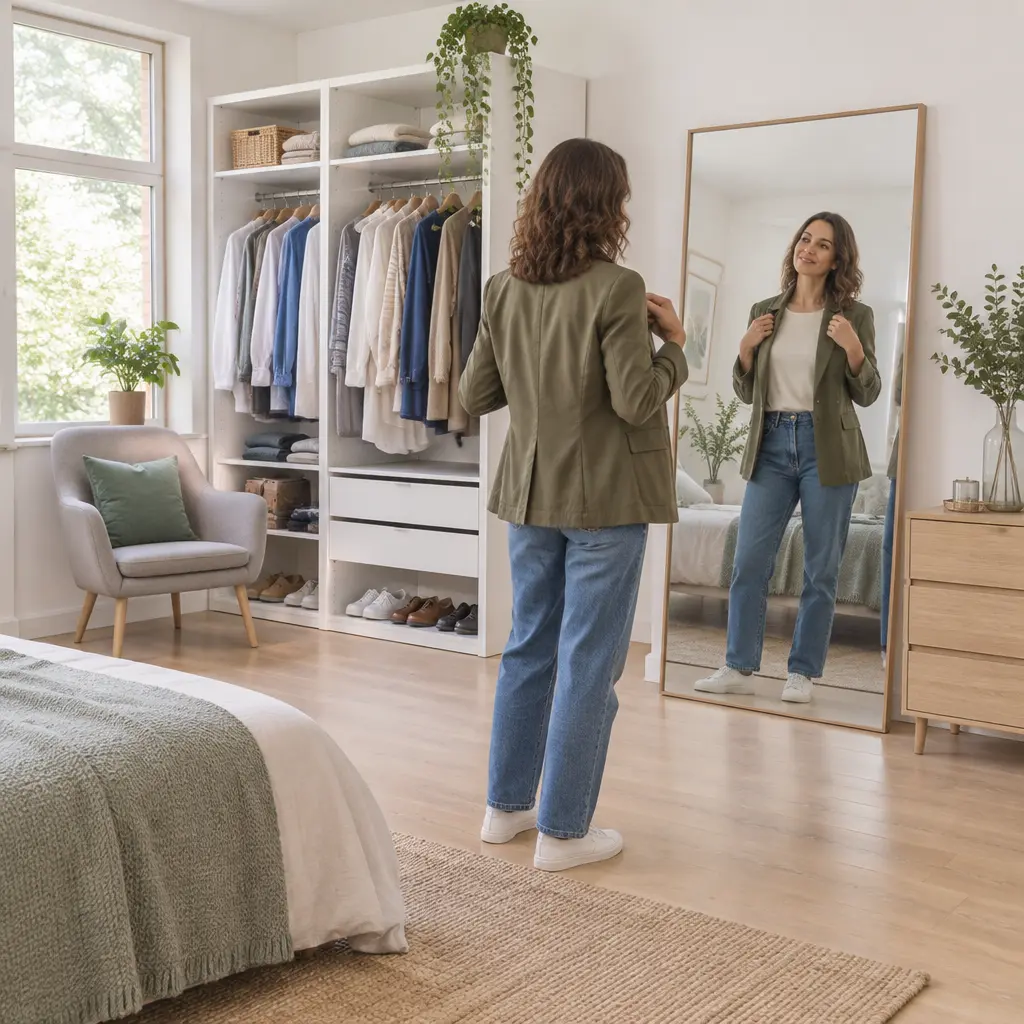
A casual outfit can pair a comfortable base with one structured or distinctive piece. For example, try straight-leg jeans, a soft T-shirt, and a relaxed blazer; or combine a knit top, loose trousers, and sneakers. Adjust the proportions, colors, and footwear to suit your preferences and activities rather than aiming for a universally “correct” look.
Work and occasion dressing
For work or a special event, start with the dress code and the tasks you need to do. A matching jacket and trousers can feel polished; a dress with comfortable shoes can be an easy one-piece option; and separates can offer flexibility across temperatures. If you will be standing or walking for long periods, comfort and practical footwear are part of a successful outfit, not afterthoughts.
Layering for changing conditions
Layering means wearing garments together so you can adjust to temperature, activity, or a change in setting. A light base layer, a shirt or knit, and a coat provide options without requiring a completely different outfit. Varying lengths and textures can add visual interest; a mirror check helps ensure the layers feel intentional and allow easy movement.
Build a wardrobe around preference, use, and repeat wear
A useful wardrobe supports the life you actually lead. The U.S. Environmental Protection Agency reported that 17 million tons of textile waste were generated in the United States in 2018, with 2.5 million tons recycled. Those figures underline the value of making considered choices, though buying less is not the only answer: caring for, repairing, rewearing, and responsibly passing on clothing can also extend its use.
Use a wardrobe audit
A wardrobe audit is a review of what you own, what you wear, and what is missing for your routine. Notice which garments you reach for repeatedly and why: perhaps they are comfortable, versatile, easy to wash, or simply feel like you. Identify pieces that are difficult to combine, need repair, or no longer suit your needs before deciding whether to alter, donate, resell, or recycle them.
Try before you adopt a style rule
Style advice is most useful when treated as an experiment. If you have heard that a certain hemline, print, or silhouette is “wrong” for your body, try it in a low-pressure setting and assess the result for yourself. Keep what feels comfortable and expressive; adapt or ignore the rest. Personal preference is meaningful evidence about whether an outfit works for the person wearing it.
Conclusion: Dress for the effect and comfort you want
Personal style offers a more flexible way to think about flattering outfits than strict body-type rules. Fit and comfort help clothing work in real life; proportion and silhouette shape the overall look; color, texture, and details add character; and outfit formulas make daily dressing easier. Start by identifying what you enjoy wearing, test combinations in your own wardrobe, and make adjustments for comfort and occasion. For further exploration, consult museum fashion resources, learn basic garment-care and repair skills, and use your next wardrobe review to make room for pieces you will genuinely wear.
Sources: U.S. Environmental Protection Agency, Facts and Figures about Materials, Waste and Recycling: Textiles, https://www.epa.gov/facts-and-figures-about-materials-waste-and-recycling/textiles-materials-specific-data; U.S. Bureau of Labor Statistics, Consumer Expenditures, https://www.bls.gov/cex/; Museum at the Fashion Institute of Technology, Fashion and Textile History resources, https://fitnyc.edu/museum/collections/.


