
Affordable fashion and budget beauty mean choosing clothing, accessories, and personal-care products that fit your finances while still looking current, intentional, and well cared for. The most reliable formula is to spend strategically on fit, fabric, versatile basics, and a few timely details; maintain what you own; and choose makeup or skincare for suitability rather than price or packaging. This matters because U.S. household spending on apparel and related services averaged $2,041 in 2023, according to the Bureau of Labor Statistics, while the Environmental Protection Agency estimates that 11.3 million tons of textile waste entered U.S. landfills in 2018. A considered wardrobe and beauty routine can protect a budget, reduce avoidable waste, and help a polished look last.
Affordable fashion is built on fit, fabric, and outfit cost
Affordable fashion is clothing selected to meet a person’s needs at a manageable price without treating the lowest sticker price as the only measure of value. There is no universal academic definition of “looking cheap” or “dated”; in practical styling, the concern usually refers to poor fit, visible wear, awkward proportions, or items that do not work with the rest of an outfit. A more useful standard is cost per wear: the purchase price divided by the number of times an item is worn. This measure is a planning tool, not a guarantee that a higher-priced item is better.
The Bureau of Labor Statistics’ Consumer Expenditure Survey reported average annual U.S. household spending of $2,041 on apparel and related services in 2023. That is a population average, not a recommended budget: household size, location, income, work requirements, and personal needs all affect appropriate spending. The number does, however, show why deciding what to buy before shopping can matter. A short list of wardrobe gaps is more useful than chasing every trend or sale.
Fit and proportion
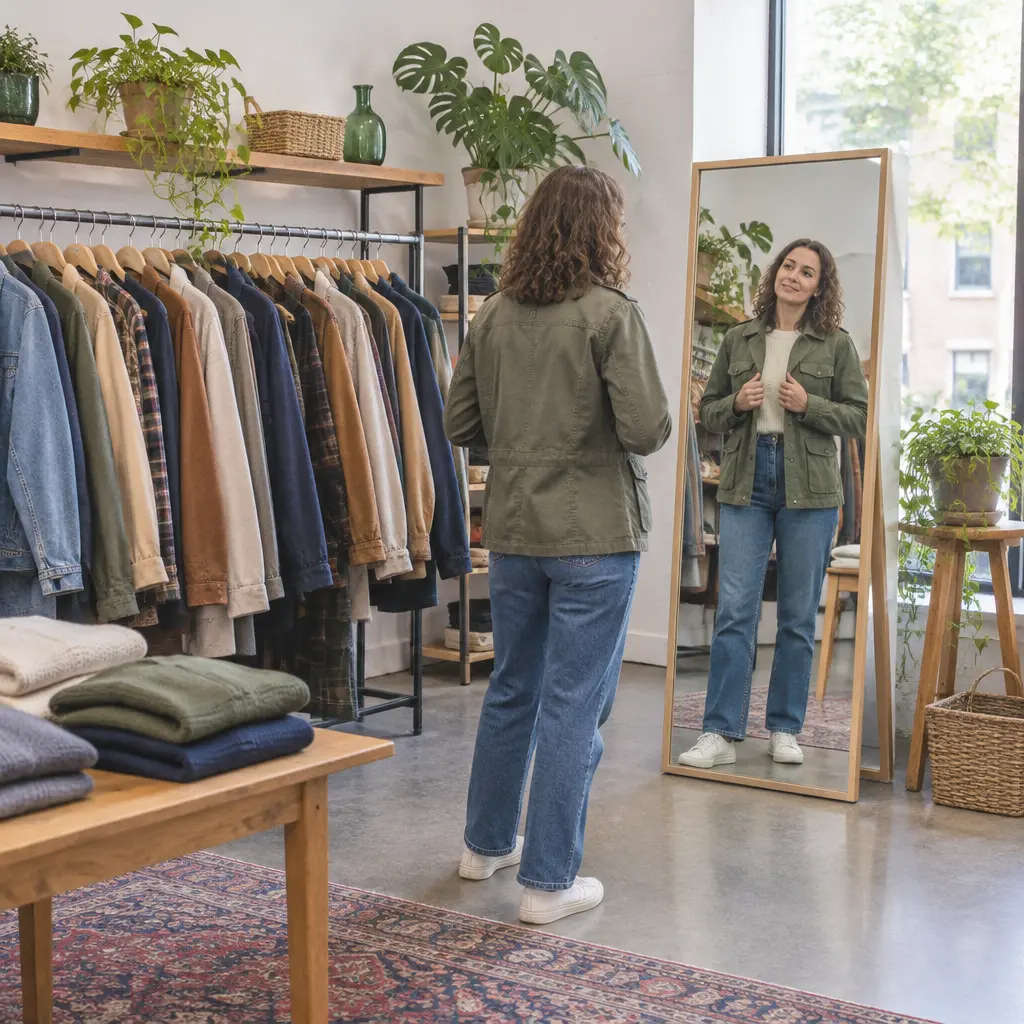
Fit describes how a garment sits on the body and moves during ordinary activities. Shoulders, sleeve length, waist placement, trouser break, and hem length often influence the finished look more than a brand label does. Try items on while seated and walking, and check whether closures lie flat and fabric pulls or bunches. Basic alterations—such as hemming trousers or shortening sleeves—can improve an inexpensive garment when the alteration cost still makes sense.
Fabric, condition, and care
Fabric quality is the material’s suitability for the garment’s purpose, including how it drapes, feels, and tolerates care. Read fiber and washing labels, check seams and fastenings, and inspect secondhand pieces for stains, pilling, thinning, or repairs. Natural fibers are not automatically superior for every use, and synthetic fibers are not automatically poor; climate, comfort, durability, and care needs all matter. The Federal Trade Commission’s Care Labeling Rule requires care instructions on many covered garments, making the label a practical guide to upkeep.
Care also connects affordability with waste prevention. The U.S. Environmental Protection Agency’s textiles data estimates that 17 million tons of textile waste were generated in 2018, with about 11.3 million tons landfilled. The agency’s figures describe a broad textile-waste category, not only wearable clothing, but they underline the value of wearing, repairing, donating, or responsibly reusing items instead of discarding them prematurely.
Versatile basics and cost per wear
Versatile basics are pieces that coordinate with several items already in a wardrobe: for example, a well-fitting pair of trousers, a simple knit, or a jacket suited to the local climate and daily routine. Before purchasing, imagine at least three outfits using the item. Then estimate cost per wear: a $40 garment worn 20 times costs $2 per wear, while a $15 item worn twice costs $7.50 per wear. The calculation is illustrative; it does not account for resale value, repairs, or differences in comfort.
Once fit and wardrobe function are in place, trend choices can add freshness without requiring a complete seasonal overhaul. The distinction is between a deliberate accent and a closet full of short-lived purchases.
A current-looking wardrobe balances trends with personal style
Personal style is a repeatable way of combining clothes that reflects a person’s preferences, practical needs, and context. A current-looking outfit does not need to reproduce a runway or social-media look; it can use familiar shapes with one updated detail, such as a color, accessory, or proportion. That approach limits impulse buying and makes new pieces easier to combine with existing clothes.
Use trends as accents
A trend is a style or product gaining attention during a particular period. Because trends change, try them first through lower-cost, easily re-worn accents—such as a scarf, jewelry, nail color, or secondhand piece—rather than replacing a whole wardrobe. Choose only trends that suit your comfort, activities, and existing colors. If a trend works with several outfits and feels like you, it is more likely to earn repeat wear.
Shop secondhand and assess the full cost
Secondhand shopping is the purchase of previously owned clothing through charity shops, resale stores, consignment shops, or online marketplaces. It can widen access to different price points and extend a garment’s useful life, but the same checks apply as in a new purchase: inspect condition, confirm measurements, understand return policies, and include cleaning or repair costs. A low price is not a saving if the item cannot be worn, does not fit, or requires expensive alterations.
Build outfits around coordination
Coordination means that colors, textures, and proportions work together across multiple outfits. A practical wardrobe can start with a small palette of colors that suit the wearer and combine easily, then add a few contrasting pieces for variety. This is not a demand for a minimalist closet: it is a way to make purchases more useful. Photographing successful outfits or keeping a short list of missing items can also help reduce duplicate buys.
The same value-first approach applies to beauty. A product’s price or trend status does not establish that it is appropriate for someone’s skin, routine, or budget.
Budget beauty prioritizes suitability, safety, and routine
Budget beauty is a personal-care routine planned around affordability and individual needs, rather than the assumption that a larger product collection or premium price is necessary. The American Academy of Dermatology recommends a simple basic skincare routine centered on cleansing, moisturizing, and sun protection; individual needs can differ, and persistent skin concerns are best discussed with a qualified health professional. For makeup, a few comfortable, versatile products can be more useful than buying every popular launch.
Choose products for the person and the use
A suitable product is one that works for its intended purpose and is tolerable for the person using it. Consider skin sensitivity, hair type, climate, wear time, and how often the product will be used. Read ingredient and use directions, and introduce new skincare products cautiously rather than changing an entire routine at once. The American Academy of Dermatology advises testing a new skincare product on a small area of skin before regular use; stop using a product that causes a reaction and seek medical advice when needed.
Compare unit price and likely use
Unit price is the cost per standard quantity, such as an ounce or milliliter, and can make comparisons between different package sizes clearer. It is most useful when comparing similar products, but it does not show whether a product will suit the user or be finished before its useful life ends. A larger package is not a bargain if it expires, irritates the skin, or goes unused. For makeup, consider whether a product fills a real gap and whether its shade and finish will work with items already owned.
Use cosmetics hygienically and follow labels
Cosmetic hygiene means storing and using products in ways that limit contamination and following product-specific directions. The U.S. Food and Drug Administration advises consumers not to share makeup and to keep containers clean; eye cosmetics deserve particular care because the eye area is sensitive. Follow the manufacturer’s instructions, discard products when their condition or safe-use period is uncertain, and do not add water or saliva to products to change their texture. In the United States, cosmetics generally do not receive FDA premarket approval, apart from color additives and certain other legal requirements, so consumers should not treat price or popularity as proof of safety.
For a practical illustration, imagine someone preparing for work with a limited monthly budget. They could first list clothing needed for the actual dress code, then check whether existing pieces can form outfits, repair a loose button, and buy only a missing item after comparing fit and care requirements. For beauty, they might keep a gentle cleanser, moisturizer, and broad-spectrum sunscreen if appropriate for their routine, then add one makeup product they know they will use. The example is a planning method, not a claim that the same products or wardrobe suit everyone.
A practical budget plan helps purchases look intentional
A budget plan turns broad intentions into decisions at the point of purchase. It can account for seasonal needs, replacements, alterations, personal-care basics, and occasional treats without requiring a fixed percentage that may not suit every income or household.
Use a pause-and-check shopping method
- Check what is already owned and identify a specific gap.
- Set a maximum price before browsing, including likely shipping, cleaning, or alteration costs.
- Assess fit, condition, care needs, and whether the item works with at least three existing outfits or uses.
- Compare the total cost and likely frequency of use, not just the sale price.
- Wait before buying a nonessential item; return to it later if it still fits the plan.
Maintain, repair, and rotate
Maintenance includes following care labels, cleaning items appropriately, storing them well, and making small repairs before damage worsens. Rotating clothing and beauty products can make use more visible and reduce forgotten purchases. For clothing, routine repairs such as replacing a button or securing a seam may extend use; for cosmetics and skincare, keep track of opening dates where useful and follow the product’s instructions rather than holding on to products indefinitely.
Conclusion: Affordable style comes from deliberate choices
Affordable fashion is most effective when fit, condition, versatility, and cost per wear matter more than a low sticker price. A current-looking wardrobe can combine durable basics with carefully chosen trend accents, secondhand finds, and regular care. Budget beauty works similarly: choose products for suitability and safe use, compare meaningful costs, and build a routine around actual needs. These habits can help people spend more intentionally while reducing avoidable clothing and product waste. Before your next purchase, check your wardrobe or beauty shelf, write down the gap you want to fill, and compare options against your budget and routine.
Sources: U.S. Bureau of Labor Statistics, Consumer Expenditures—2023, https://www.bls.gov/news.release/archives/cesan_09252024.htm; U.S. Environmental Protection Agency, Textiles: Material-Specific Data, https://www.epa.gov/facts-and-figures-about-materials-waste-and-recycling/textiles-material-specific-data; Federal Trade Commission, Care Labeling Rule, https://www.ftc.gov/legal-library/browse/rules/care-labeling-rule; American Academy of Dermatology Association, Skin care on a budget, https://www.aad.org/public/everyday-care/skin-care-basics/care/skin-care-budget; American Academy of Dermatology Association, How to test skin care products, https://www.aad.org/public/everyday-care/skin-care-secrets/routine/test-skin-care-products; U.S. Food and Drug Administration, Cosmetics: Safety Q&A, https://www.fda.gov/cosmetics/resources-consumers-cosmetics/cosmetics-safety-qa-personal-care-products


